May 15, 2010

Hot Spots: Bangkok, the other City of the Angels


LA and Bangkok have many connections.

At the least, both Pacific Rim cities are named for angels: Los Angeles, and Krung Thep, กรุงเทพฯ, City of Angels.

I admit I've had a hard time grasping the minute details: yellow shirts, red shirts, et als.

My understanding is it's about the business class, allied with the military, vs. the poorer classes and opposition.

And there's some type of electoral fraud thrown in for good measure.

And of course, manipulation.

Surprise!

I promise I'll inform myself better in the near future, mea culpa.

I've always admired Thailand for having had a wise monarchy; during the height of European expansionism in South East Asia, the Thai king negotiated a colonial-free Siam (later, Thailand, Land of the Free), making Thailand the only SE Asian country never colonized.

Interestingly, since a constitutional monarchy was established in 1932, Thailand has had various coups; and now, according to some sources, the country is on the brink of a civil war.

The King hasn't gotten involved; which, to me, is surprising.

When there is live fire on the streets in Krung Thep, I'd think he'd take a side and then use his powerful moral authority to stop the violence.

But, as I said, I don't understand the intricacies of the Thai situation.

Filmed on the streets of Bangkok this week:


The immediacy of this video is frightening. It feels so real you almost smell gunpowder. It views like the best live journalism; another tribute to new media and the power of the individual. I imagine myself in that alley, hearing all the gun shots; trembling, full of adrenaline.


Last year, during the height of the unrest in Iran, I saw a number of videos shot from behind gates and fences and other barriers. This video from Krung Thep reminded me of those in Iran.

.

January 4, 2010

Quechua Commercial


This is no news to anyone who pays attention to what goes on in Peru, but as my first 2010 post at LAX-LIM, I wanted to comment.

Is it a good thing Quechua is used as a marketing tool for a multinational cellular phone company?

I don't care.

I like the fantasy of the well-dressed women, in upscale pseudo-traditional clothing, in beautifully appointed settings, selling Movistar, in Quechua.

I know it's capitalism to the nth degree, but I wish this was the reality in Peru: indigenous people being wealthy, having nice surroundings, and being able to be on TV in Quechua.

There are many loan words from Quechua in Peruvian Spanish, but Quechua itself is seen as having very little value as a language.

Why learn Quechua if you can learn English, or better yet Mandarin, seems to a prevailing stream of thought.

A language is not just the sum of how many people speak it, or how much money you can make from being able to communicate in it.

Quechua is a connection to a long history: it represents a cosmology, a vision of the world.

I can only speak English and Spanish; damn, I wish I knew Quechua as well.


.

September 4, 2008

Andean Women Learning To Read In Quechua & Spanish


A recent article by Flor Huilca, a Cuzco correspondent for La República newspaper, profiled Andean women who leave their homes and fields to head to class with their children and learn to read in Quechua and Spanish.

As Huilco writes: "It is never too late to learn. Robertina, Juanita, Cristina, and Jesusa, all women from native communities in Espinar, know this all too well and have decided to attend literacy class once a week."

For the first time, these women can read and write their and their children's names, as well as signs they encounter.

According to Huilco, some women "like Juana Huacarpuma may take a while to syllabicate Quechua words like simi (language, mouth), sipas (young woman), and sisi (ant) but her reward is undeniable. At 42, this was the first time Juana had ever entered a classroom and sat at a desk."
Some of her classmates walk two hours each way to class.

Huilco explains Huacarpuma had never been sent to school by her parents, but finally, as an adult, she enrolled in the literacy program at K'anamarca Espinar.

She says she's learning, "little by little". Learning to hold and control the pencil was a challenge at first, but it is no longer.

Interestingly, even though she is fluent in Quechua, she thinks she reads and writes better in Spanish, since she always thought, "Quechua was just for speaking, not for writing." Now, Juana can read and write and help her children with their homework.

Huilco also tells the story of Cristina Kataca who had gone to school as a child but had forgotten almost everything. She could read slowly, write her name and her Peruvian identification card number, she knew how to sign her name, but she wouldn't dare to try anything else. After six months of classes, she has advanced considerably in reading and writing.

There is something poignant about the struggle of these women to attain literacy, something so many of us take for granted.


According to the article, 73% of 175,000 illiterate people in the Cuzco region are women, usually living in extreme poverty.

The regional government is trying to create a year-long program, which consists of ten units in Spanish and four in Quechua. Materials used reflect the reality of the communities where the program is being implemented.

Read the entire article at this link.


Image
De lejos. Muchas de las participantes en el programa acuden a recibir clases desde lejanas comunidades de la provincia de Espinar.

Image
En voz alta. Esta campesina repasa la lectura aprendida y demuestra que es posible ser madre, ser esposa, trabajadora del campo, y a la vez aplicada alumna.

Image
Aplicada. Esta joven madre parece demostrarnos que si ella puede, otras mujeres iletradas también.

Image
Participan mujeres de toda edad.


blog it

September 1, 2008

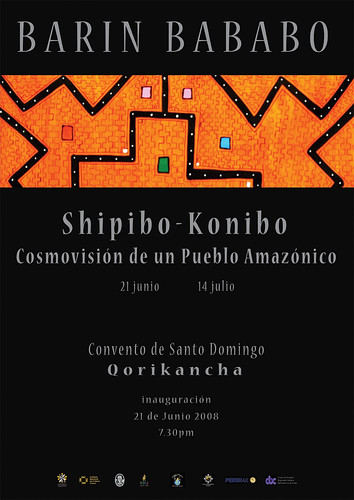
Barin Bababo: Shipibo Konibo: Cosmovision of an Amazonian People


In the slums at the base of Cerro San Cristóbal, an arid mountain rising on the far side of the Rimac River from Lima's historic center, there is a community called Cantagallo. It is where the Shipibo people, who have migrated from the Amazonian region of Peru to its desert capital, live.

Amidst the precarious homes and the nearby traffic belching out pollution, young Shipibo artists create beauty: paintings that reflect their unique Amazonian cosmology.


This talented collective of young indigenous artists have had numerous shows in Lima and other parts of Peru.


These are three videos of members of the Shipibo tribe, who come from the fertile valleys of the Pucallpa region in the Peruvian Amazonian, to live in the center of arid Lima.


Sources & Photos: Barin Bababo Blog, Barin Babao at Flickr.


August 24, 2008

Los Canarios & The Plane Crash In Madrid

Paso Doble Islas Canarias sung by
Agrupación Folclórica San Cristóbal
of Las Palmas de Gran Canaria


As a young man, I lived for four years in Spain, two in the Canary Islands.

I lived, loved, laughed, cried, grew, sang, learned on Gran Canaria.

For most Europeans, Gran Canaria is just holiday spot.

For me, it is the place whence I met one of my dearest life-long friends. An island that accepted me as I was, warts and all.

And, although I haven't been back in many years, I still attempt to keep abreast of the happenings on those seven islands off the coast of northwest Africa that belong to Spain, las Islas Canarias.

A friend of mine wrote a thesis on the Canaries as the prototype for the Conquest of the New World.

There is truth to that argument, but what I took away from the Canaries is that it serves as a bridge between Europe and the Americas, between penninsular Spain and the legacy of Spain in the Western Hemisphere.

The tragic plane crash in Madrid, in which more than half of the passengers lived on Gran Canaria, made me shudder. The notion of whole families being wiped out is beyond my grasp.

As a frequent flyer, I realize how tenuous that fine line is between life and death, between survival and destruction, between what is in one's in control and what is truly out of one's control.

Like so many others, I weep.

The paso doble Islas Canarias has a beautiful line at its end, when the main singer says:
El mundo tiene una Europa,
Europa tiene una España,
España tiene un jardín,
Que son ¡las islas Canarias!


August 20, 2008

A River Cries Out: The Rimac River Project


Río Rimac, Rimac River.

In the old days, they called it El Río Hablador, The River That Speaks.

During the winter rains in the Andes, the water would rush down so forcefully the sound of the constant grinding of the giant boulders that line the riverbed seemed to make a noise akin to talking.

I think that still happens at the height of the rainy season in the Andes; but, mostly when I think of the Rimac in its current state, I just imagine a polluted, uncared-for, and abandoned river.

As the Rimac approaches, and traverses Lima, it is akin to a giant garbage disposal system.

Three Peruvian artists (Jorge Luis Baca de las Casas, Alejandro Jaime Carbonel, Guillermo Palacios Pomareda) felt the same way, but decided to do something about it, creating the Proyecto Río Rimac, the Rimac River Project, which is both a love song and an accusation, a testament and denunciation.

They decided one way to raise awareness about this emblematic river was to walk, during 21 days, the entire length of the Rimac, from its genesis in the high Andean puna to the spot in the Callao Naval Base where its waters meet the ocean.


They took photographs, drew pictures, videographed, and blogged the project, from beginning to end.

Their blog is available in English and Spanish, and they plan on having an exhibition at the Centro Cultural de España, the Cultural Center of Spain, in Lima, during the APEC conference this coming October.

I posted the above photos from the Río Rimac project.

It was too depressing to post the pictures of the river after man's polluting hand.

Definitely worth checking out the following links:

Proyecto Río Rimac blog

They have great photos on Flickr, here are the links:


first four days


days 5 to 8

days 9 to 12

days 12 to 14

days 15 to 17

day 18

day 19

day 20

day 21

There was also a report on the Peruvian television program, Cuarto Poder, that discussed the project in Spanish.

Here is that video, in two parts:


August 19, 2008

Computer Panic


I admit it.

I curled up into a fetal ball and moaned as I lay in the center of my apartment after seeing the screen telling me there was a major problem with my operating system.

It took me at least a couple of days, and the help of a resilient friend, to drive around LA's Koreatown until we located a computer repair shop. The fragile CPU sat in my arms, like a forlorn babe awaiting redemption.

In a non-descript office building, brimming with signs in Hanjul, I found the temple of resurrection.

Surprisingly, or not for my hood, it was run by a Salvadoran who took pity on me, but still told me it would be over the weekend before he could diagnose the problem.

Early Monday morning the phone rang, and the problem was resolved almost effortlessly.

Nonetheless, for the first time in a long while I spent five long days without internet access, other what I was able to glom off sympathetic friends.

I realize: in the urban jungle in which I live, there are certain necessities of life, which include a phone, a car, and a computer. They have become the technological holy triad of the twenty-first century.

Thank you, Pachamama, for making sure everything worked out again...


August 1, 2008

Urban Spiderwebs...


That's how a friend describes the freeways of Southern California; I think of them as arteries, pulsating, maintaining alive the movement of people and transport across this vast urban/suburban landscape which is so confusing to those who arrive from elsewhere, but to me seems as familiar as the lines on the palms of my hand. There is beauty in the lines on my palms; there is beauty amidst the chaos of our freeways...


January 21, 2008

Happy Birthday!


One of my heroes...Dr. Martin Luther King...


January 13, 2008

Hungry?


Something to celebrate the Year of the Potato...


October 22, 2007

Just A Street In Trujillo


Just one of those things you see when wandering around the historic part of this historic city.


October 21, 2007

Crenshaw


October 19, 2007

A Shop in Orcotuna


My maternal grandfather's town: the ancestral village.

A shop:

two lads,
musicians resting,
drink on the floor,
merchandise on the shelves.
Orcotuna.

Wanka walarshmi ka...


September 3, 2007

It Must Be Venice...


Mural along the Venice boardwalk.

August 30, 2007

Angelino Sign


What you see anywhere, any night, here in LA...


August 13, 2007

Munchkin Patterns


Well, they are just in kindergarten.


August 6, 2007

Crab Soup In Barranco


Man, this makes me so hungry...


August 4, 2007

Jesus, Beer, and Inca Kola


Just something I found in the small Andean town of Jauja.


July 30, 2007

Tiles


One day I went to the Mercado La Paloma, here in Los Angeles, and came across this tile wall.


July 22, 2007

Street Art In The Amazon

I was walking along a street in the hot and humid Amazonian town of Nauta, about 50 miles from Iquitos, when I spotted this doorway, a combination of art and religion.